1. Who are the electric wire manufacturers in India?
India has many electric wire manufacturers, from large national brands to specialised regional makers. Nimacab, based in Sector 94, Noida, is one such manufacturer, supplying electric cables and wires, solar DC cables and power cords for homes, industries and export buyers. When comparing manufacturers, look at product range, testing practice, customisation and delivery capability, not just price.
2. Which companies supply bulk electrical cables in India?
Many Indian manufacturers and distributors supply bulk electrical cables. Nimacab supplies bulk and OEM orders of house wires, armoured and unarmoured power cables, FR/FRLS wires, LSZH cables, solar cables and power cords to dealers, contractors, EPC companies and industrial buyers. Share your cable type, size, quantity and delivery location on our contact page to get a bulk quote.
3. Where can I find industrial cable manufacturers in India?
Industrial cable manufacturers are concentrated in industrial hubs such as Delhi NCR, including Noida and Ghaziabad, as well as Gujarat, Maharashtra and Tamil Nadu. In Noida, Nimacab makes armoured and unarmoured power cables, FR/FRLS wires and LSZH cables for industrial use. You can also browse our shop or services page for the full range.
4. What should I check before selecting an electrical cable supplier?
Check these six things before choosing a supplier:
Certifications and test reports: ask for BIS/ISI marking and test documents where applicable.
Conductor material and size: confirm copper or aluminium and the exact cross-section.
Insulation and sheath type: PVC, XLPE, FR/FRLS or LSZH, depending on the application.
Voltage and temperature rating: it must suit your load and environment.
Customisation and bulk capability: can they handle your volumes and OEM needs?
Delivery, documentation and after-sales support: check lead times and paperwork, especially for export.
5. Which cable specifications are important for infrastructure projects?
For infrastructure projects, the key specifications are:
Conductor: material (copper or aluminium), cross-sectional area and number of cores
Voltage rating: for example 1.1 kV low-voltage or higher medium-voltage grades
Insulation and sheath: PVC, XLPE or LSZH
Armouring: armoured cables for mechanical protection and direct burial
Fire performance: FR/FRLS or LSZH for buildings, tunnels, hospitals and public spaces
Standards compliance: Indian (IS/BIS) or international (IEC/BS) standards as the project requires
Test certificates: routine and type test reports
6. How can international buyers source cables from India?
International buyers can source cables from India by following these steps:
Shortlist manufacturers that offer the cable types and certifications your market needs.
Send an enquiry with cable type, size, quantity, destination and applicable standards (for example IEC, BS or UL).
Request a quotation, samples and test reports.
Confirm packaging, Incoterms, lead time and payment terms.
7. What is the difference between Indian and international cable standards?
Indian cables follow Bureau of Indian Standards (BIS) specifications such as IS 694 for PVC insulated cables, IS 1554 for heavy-duty PVC cables and IS 7098 for XLPE cables. International markets commonly use IEC standards, the UK uses BS standards and North America uses UL/CSA standards. They differ in voltage ratings, conductor sizing conventions, insulation requirements, colour codes and testing methods. Exporters should match the cable to the destination market’s standards. Confirm the exact standard with your supplier before ordering.
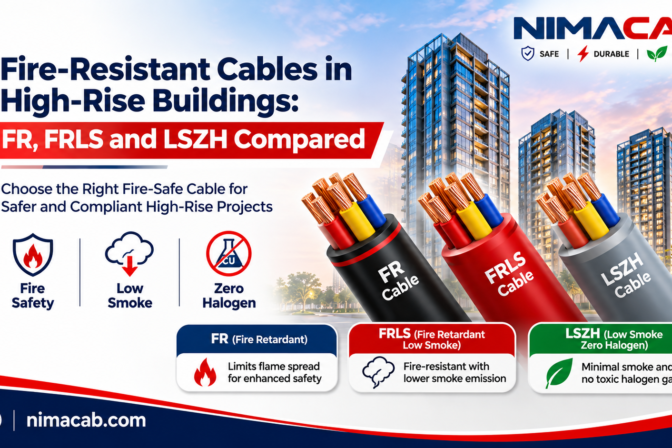
Where are FRLS cables used?
FRLS cables are used wherever smoke could endanger people or equipment, mainly in enclosed or crowded spaces:
Hospitals and healthcare facilities
Shopping malls, cinemas and hotels
Metro and railway stations
Airports and public infrastructure
Data centres and server rooms
High-rise residential and commercial towers
Industrial plants with limited ventilation
Scan the code
Interested in our products? Let's talk! Click below to chat with Nimacab on WhatsApp