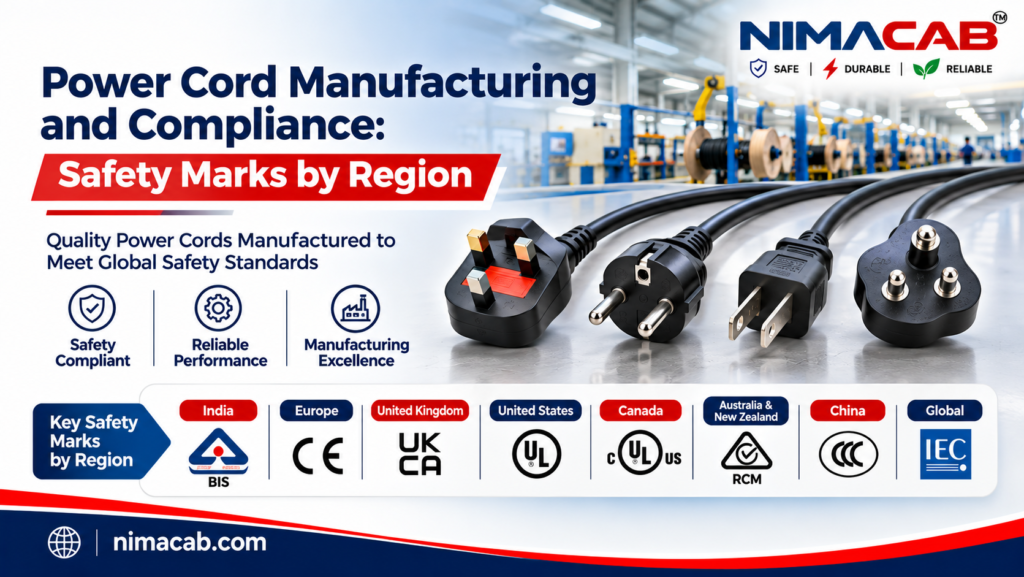
Power cords are simple-looking products with serious safety responsibilities. A poorly made cord can overheat, loosen or expose live parts, so most markets require cords to meet defined standards and often carry recognised approval marks.
Requirements vary by region. North America relies on listing by recognised laboratories and specific cord types. Europe uses harmonised standards and conformity marking. The UK, Australia, India and many other countries have their own rules and plug shapes. Cords must also match the appliance’s connector, current rating and operating temperature.
A practical approach for exporters is to build a compliance matrix: a simple table listing each target country, the required marks or approvals, the applicable plug type and the responsible party for testing and documentation. Update it regularly, since regulations evolve. Share the relevant row with your manufacturer before each order so nothing is missed. Consider working with local importers who already hold the necessary approvals. This disciplined approach reduces the risk of blocked shipments and protects your reputation with customers who rely on you for compliant, ready-to-sell products.
Appliance makers should confirm requirements for each target market before ordering, since approvals may relate to both the cord and the finished product. Reliable suppliers can adapt plug type, length, conductor size and jacket material for each destination. Nimacab supplies power cords with OEM and custom manufacturing options, and can help exporters and appliance makers plan bulk sourcing in line with regional needs.
Looking for power cord compliance? Nimacab manufactures power cords and connectors for bulk and OEM orders from Noida, India. Explore our range at https://nimacab.com/services/or request a quotation at https://nimacab.com/contact/
1. What are safety marks on a power cord?
Safety marks are approval or certification symbols showing that a power cord has been tested against the standards of a particular market. They tell buyers, importers and customs authorities that the cord meets defined safety requirements for things like overheating and exposed live parts.
2. Why does power cord compliance matter for exporters?
Non-compliant cords can be blocked at customs, returned or rejected by distributors, and they put end users at risk. Meeting the destination market’s requirements protects your shipments and your reputation with customers who expect ready-to-sell products.
3. What is a power cord compliance matrix?
A compliance matrix is a simple table that lists each target country, the required marks or approvals, the applicable plug type and who is responsible for testing and documentation. Update it regularly, since regulations change, and share the relevant row with your manufacturer before every order.
4. What are the major international power cord standards?
Common standards and regulatory frameworks may include IEC 60320 for appliance couplers, IEC 60227 and IEC 60245 for certain cable types, UL and CSA standards for North American products, and applicable national standards for plugs and cord sets. The relevant standards must be selected according to the product design and destination market.
5. What information should buyers provide when ordering customized power cords?
Buyers should provide the intended destination country, plug type, connector type, voltage and current ratings, cable length, conductor size, insulation material, required certifications, and application details. This information helps manufacturers determine the appropriate design and compliance requirements.
6. What is the difference between a power cord and a power cable?
A power cord is generally a flexible electrical assembly used to connect an appliance or equipment to a power source. It may include a plug, flexible cable, and connector. A power cable is a broader term referring to electrical conductors used to transmit power in different applications, including industrial, commercial, and residential installations.