High-rise buildings concentrate people, and evacuation can take time, so the fire behaviour of cables matters greatly. Specifiers use several terms that are often confused, and understanding them helps buyers select correctly.
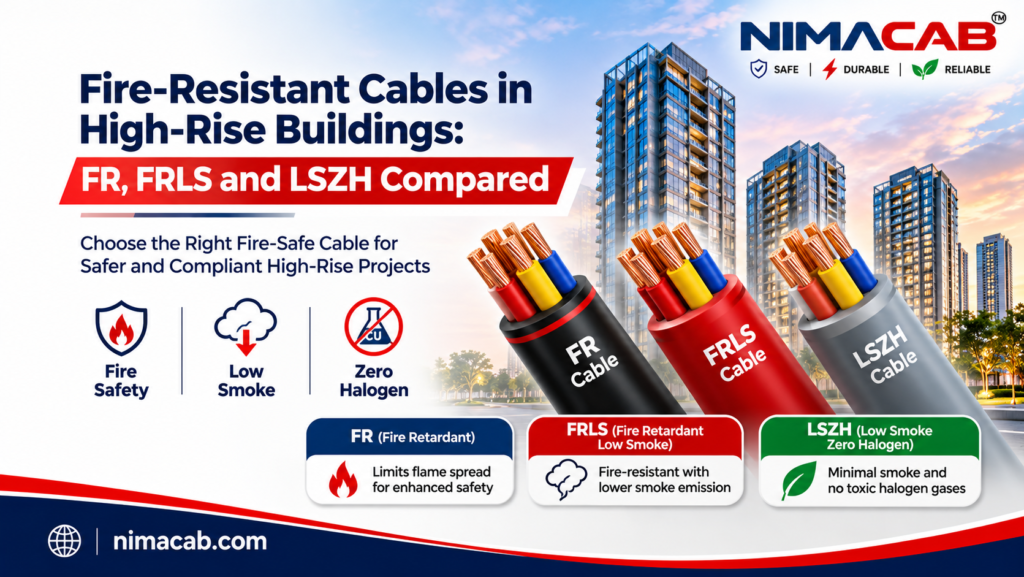
FR (flame retardant) cables resist the spread of flame along their length. FRLS (flame retardant low smoke) adds reduced smoke emission, improving visibility during escape. LSZH (low smoke zero halogen) cables limit both smoke and halogen gases, which reduces toxicity and corrosion. None of these is the same as fire-resistant or fire-survival cable, which is designed to keep operating for a set time during a fire and is used for emergency lighting, alarms and smoke-control systems.
Design documents should specify not just the cable type but the performance class, test standard and required approvals for each circuit. Coordinate with fire engineers so that cable choices align with the building’s fire strategy, including compartmentation and smoke control. On site, fire-stopping at penetrations and proper support systems are essential to preserve the intended performance. Inspect and test installations before handover, and keep documentation available for future audits. A holistic approach, combining correct materials, careful installation and ongoing maintenance, gives building owners the best protection.
Project specifications and local codes decide which type applies to each circuit. Buyers should request test certificates and confirm that the product matches the standard cited. Nimacab manufactures FR and FRLS wires and LSZH cables as part of its wire and cable range, and can support developers, contractors and distributors with bulk supply.
Looking for fire resistant cables high-rise? Nimacab manufactures electric cables and wires, including armoured, unarmoured, FR/FRLS and LSZH options for bulk and OEM orders from Noida, India. Explore our range at https://nimacab.com/services/or request a quotation at https://nimacab.com/contact/