
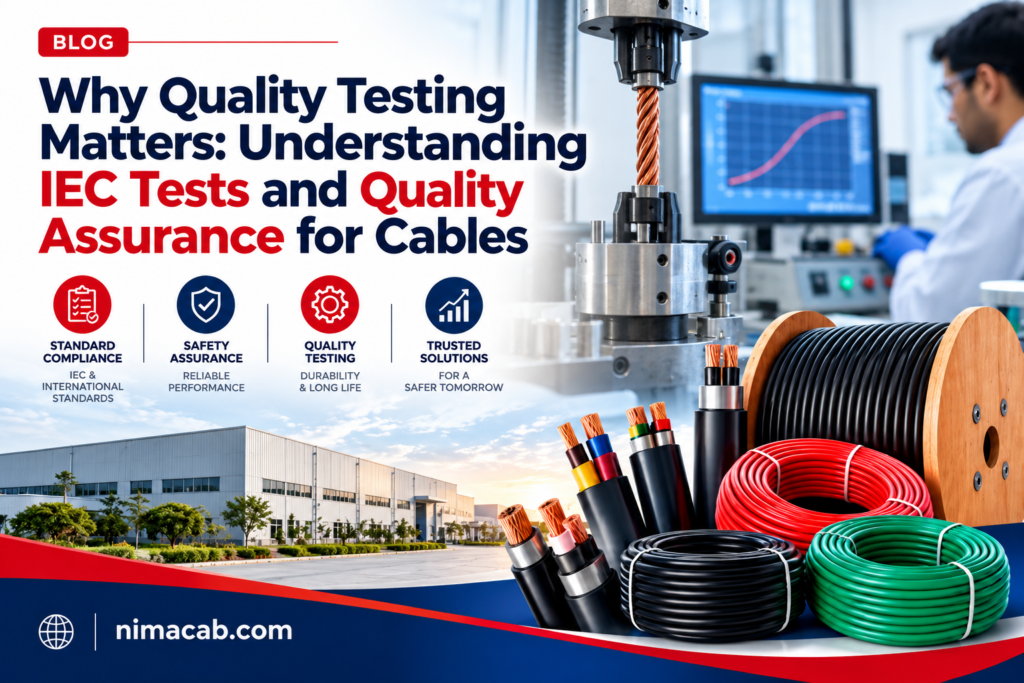
Cable failures are costly and dangerous, and because cables are typically concealed, defects may surface only after years of use. Rigorous quality testing is the manufacturer’s way to detect problems before products leave the factory.
Tests generally fall into routine, sample and type categories. Routine tests, such as conductor resistance and voltage withstand, are applied to production lengths. Sample tests check dimensions, insulation thickness and mechanical properties on selected samples. Type tests validate a design, including thermal ageing, flame propagation and other performance characteristics. International standards from the IEC and national bodies describe methods and acceptance limits.
Buyers can also use testing to differentiate suppliers. Ask which tests are performed on every production length, which are done on samples and how often. Request sample test reports and check whether the results are consistent across batches. For projects with strict requirements, consider witnessing tests at the factory or using an independent inspector. A manufacturer that welcomes scrutiny and keeps thorough records demonstrates confidence in its processes. Over time, this transparency can turn a supplier from a source of product into a trusted partner who helps you meet your own customers’ expectations.
Robust systems tie testing to traceability, so each batch can be linked to raw materials and results. Buyers should request test reports, review certificates and consider independent inspection for major orders. Nimacab provides quality testing and certification support and operates ISO-aligned quality assurance across its cables, networking equipment, connectors and power solutions.
Looking for cable quality testing? Nimacab manufactures quality-tested cables with certification support for bulk and OEM orders from Noida, India. Explore our range at https://nimacab.com/services/or request a quotation at https://nimacab.com/contact/
1. Why is quality testing important for electrical cables and wires?
Quality testing is important because it verifies the electrical performance, insulation strength, durability, and safety of cables and wires. It helps identify manufacturing defects, reduces the risk of electrical failures, and ensures that cables meet the applicable safety and performance standards for their intended applications.
2. What are the common tests performed on electrical cables as per IEC standards?
Common electrical cable tests include conductor resistance testing, insulation resistance testing, high-voltage testing, dimensional checks, mechanical strength testing, and fire-performance testing where applicable. The exact tests depend on the cable type, voltage rating, intended application, and relevant IEC standard.
3. What are IEC standards for electrical cables, and why do they matter?
IEC standards are international technical standards developed by the International Electrotechnical Commission. They define requirements and test methods for different types of electrical cables. Following the applicable IEC standards helps manufacturers, distributors, contractors, and project buyers assess cable safety, performance, and suitability for specific applications.
4. What is the difference between routine testing and type testing of electrical cables?
Routine testing is performed during production or on finished cables to check ongoing conformity with specified requirements. Type testing evaluates whether a particular cable design meets the relevant standard's performance requirements, including tests that may assess mechanical strength, ageing, or fire behaviour. The required frequency and scope depend on the applicable standard and product specification.
5. How can buyers identify quality electrical wires and cables before purchasing?
Buyers should check the manufacturer's identity, cable markings, voltage rating, conductor size, applicable standard, product specifications, and relevant test reports or certification documents. They should also verify traceability and ensure the supplied cable matches the purchase order. When necessary, independent testing can help confirm compliance.
6. How does cable quality testing benefit industrial, solar, and infrastructure projects?
Cable quality testing helps project teams verify that cables meet the electrical, mechanical, thermal, and environmental requirements of their intended use. For industrial facilities, solar installations, commercial buildings, and power infrastructure, selecting cables tested against the applicable standards can reduce the likelihood of premature failures, unexpected maintenance, and costly project interruptions.