
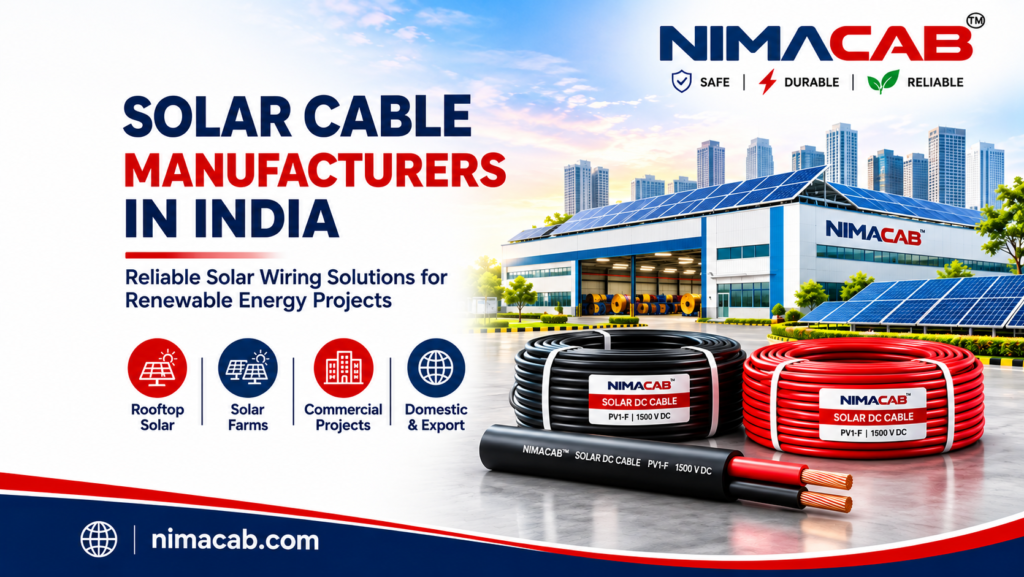
Solar plants are exposed to sun, heat, rain and temperature swings for 25 years or more. That is why working with the right solar cable manufacturer in India matters as much as choosing the panels and inverters.
What Are Solar Wires and Cables?
Solar wires and cables are electrical conductors specifically designed for photovoltaic systems. They transmit direct current (DC) electricity generated by solar panels to other components, including solar inverters and electrical distribution systems.
Unlike conventional electrical wires used for indoor applications, solar cables are designed to withstand demanding outdoor conditions.
Solar cables are commonly used in:
- Residential rooftop solar installations
- Commercial and industrial solar power systems
- Ground-mounted solar power plants
- Utility-scale photovoltaic projects
- Solar farms and renewable energy installations
- Off-grid solar systems
- Solar battery storage applications
The quality of solar cables directly influences electrical safety, energy transmission efficiency, and the overall reliability of a solar installation.
Why Is the Demand for Solar Cable Manufacturers in India Increasing?
India’s growing renewable energy sector has created opportunities for domestic wire and cable manufacturers. Solar installations require extensive electrical infrastructure, including DC cables, AC power cables, connectors, wiring accessories, and electrical distribution equipment.
Several factors are contributing to the increasing demand for solar cables.
1. Expansion of Rooftop Solar Projects
Residential buildings, commercial establishments, factories, and institutions are increasingly adopting rooftop solar systems to reduce electricity costs and improve energy independence.
Every installation requires suitable DC wiring between solar modules and inverters, along with AC cables for power distribution.
2. Growth of Large-Scale Solar Power Plants
Utility-scale solar projects require extensive cable networks connecting photovoltaic modules, string connections, combiner boxes, inverters, and other electrical equipment.
Reliable cables help support safe and consistent electricity transmission across large solar installations.
3. Increasing Renewable Energy Investments
Government initiatives, private investments, and sustainability objectives are supporting the expansion of solar energy infrastructure across India.
This creates opportunities for cable manufacturers, suppliers, distributors, and exporters serving renewable energy projects.
4. Demand for Durable Electrical Products
Solar installations are designed to operate for extended periods. Project developers therefore require cables that offer appropriate UV resistance, temperature performance, mechanical durability, and electrical characteristics.
These requirements make specialized solar cables an important component of photovoltaic systems.
Types of Solar Cables Used in Solar Power Systems
Understanding different cable types helps project developers and electrical contractors select appropriate products for their applications.
1. Solar DC Cables
Solar DC cables transmit electricity generated by photovoltaic modules to the inverter.
They are commonly used for:
- Connecting solar panels
- Connecting PV strings
- Connecting modules to combiner boxes
- Connecting combiner boxes to inverters
Solar DC cables should be selected according to the system voltage, current, installation environment, conductor size, and applicable standards.
2. Solar AC Cables
Solar AC cables carry alternating current from the inverter to electrical distribution panels or grid connection points.
These cables must be selected according to the inverter output, operating voltage, current capacity, installation method, and applicable electrical requirements.
3. Single-Core Solar Cables
Single-core solar cables are commonly used for DC connections in photovoltaic systems.
Positive and negative connections are generally made using separate conductors. Proper polarity identification and compatible connectors are essential for safe installation.
4. Flexible Solar Cables
Flexible solar cables are designed to support installations where routing and bending flexibility are important.
Their suitability depends on conductor construction, cable design, installation requirements, and the manufacturer’s specifications.
Why Choose an Indian Wire and Cable Manufacturer?
India has a developed electrical manufacturing ecosystem that supports domestic infrastructure projects and international procurement.
Working with an established electric wire manufacturer in India can offer several potential advantages.
Domestic Manufacturing Support
Indian manufacturers can support local electrical projects, distribution networks, construction activities, and renewable energy installations.
Competitive Procurement Opportunities
Domestic sourcing may provide procurement flexibility for project developers and distributors, depending on product specifications, volumes, and commercial terms.
Diverse Product Categories
The Indian wire and cable industry supplies a wide range of products, including solar cables, house wires, power cords, control cables, and specialized electrical cables.
International Supply Opportunities
India’s cable manufacturing sector also serves overseas markets.
What Makes Solar Cable Different
Solar DC cables connect panels to inverters and must withstand UV radiation, ozone, abrasion and wide temperature ranges. They are generally double-insulated and cross-linked for durability outdoors.
Features to Look For
- Tinned copper conductor for corrosion resistance and long life.
- UV, weather and ozone resistant insulation and sheath.
- Halogen-free, flame-retardant construction.
- Suitable DC voltage rating for your system design.
- Compliance with recognised solar cable standards such as EN 50618, where specified by your project.
Sizing and Installation Tips
- Select cross-section based on current and allowable voltage drop.
- Keep cable runs as short as practical.
- Use correct connectors and crimping tools.
- Protect cables from sharp edges and direct ground contact.
Solar Cables from Nimacab
Nimacab supplies solar DC cables for rooftop, commercial and utility-scale projects, with bulk supply and technical guidance. See the Electric Wire & Cable page or contact our team through services.
For quotes, samples and bulk orders, contact Nimacab at sales@nimacab.com or +91 9218191605.
Frequently Asked Questions
Why is tinned copper used in solar cables?
The tin coating protects copper from oxidation and corrosion, helping maintain conductivity over many years outdoors.
Can normal house wire be used for solar panels?
No. Standard house wire is not designed for continuous UV and outdoor exposure. Use purpose-built solar DC cable.
How do I choose solar cable manufacturers in India?
Evaluate manufacturers based on product specifications, applicable certifications, conductor quality, insulation materials, electrical performance, testing documentation, production capabilities, and supply reliability.
What is the difference between solar cables and ordinary electrical wires?
Solar cables are designed for photovoltaic applications and may require specialized UV resistance, temperature performance, insulation, and voltage ratings. Ordinary indoor wires may not be suitable for outdoor solar DC installations.
What should buyers check before purchasing solar cables?
Buyers should verify cable size, conductor material, voltage rating, current capacity, insulation and sheath properties, applicable standards, installation conditions, and supporting technical documentation.